Showing posts with label Art. Show all posts

Monday, October 24, 2011

Unseen Hobbit Art to Be Published


This, according to the BBC.

From the post...

Next year marks The Hobbit's 75th anniversary. Director Peter Jackson is making a two-part movie adaptation, the first part of which is due out in 2012.

His previous adaptations of The Lord of the Rings trilogy have picked up a raft of movie awards, including the Oscar for best picture for The Return of the King in 2004.
The White Dragon Pursues Roverandom & the Moondog by JRR Tolkien Tolkien was a talented amateur artist before The Hobbit's publication

When it was originally published, The Hobbit had 10 black and white pictures, two maps, plus binding and dust jacket designs by its author.

More than 100 pieces of Tolkien's new artwork, including drawings, maps and plans have been collected for the new publication, The Art of The Hobbit, which is published on Thursday.

The Art of Sylvia Plath


Sylvia Plath and Ted Hughes's life together inspired some of the most brilliant poetry of the last century. But Sylvia was also an accomplished artist. Frieda Hughes reveals the stories behind her mother's exquisite drawings in the Guardian.

From the piece...

On 2 November, an exhibition of my mother Sylvia Plath's pen- and-ink drawings opens at the Mayor Gallery in Cork Street in London. These pictures were given to me by my father, the late Poet Laureate Ted Hughes, who died on 28 October 1998. But they were not my only legacy from my parents, if genetic make-up has anything to do with our inclinations; I have the frequently conflicted desire to write poetry and to draw and paint also. While my parents chose to direct their primary energies into writing, despite their ability as artists, I have found it impossible to do one without the other.

Although my mother is known primarily for her semi-autobiographical novel The Bell Jar and her poetry – particularly her last collection, Ariel, published posthumously in 1965 following her suicide on 11 February 1963 – her passion for art permeated her short life. Her early letters and diary notes and poems were often heavily decorated, and she hoped that her drawings would illustrate the articles and stories that she wrote for publication.

Thursday, October 20, 2011

The Morgan's Dazzling Islamic Manuscript Paintings


They're on display now.

From a post on Salon...

Roughly when, and under what circumstances, did most of these manuscripts come to the Morgan?

Actually, in a funny kind of way, the collection was the offspring of a love affair. Belle da Costa Green was [Pierpont] Morgan’s rather attractive librarian; in November of 1908, Bernard Berenson, the famous art historian of the Italian Renaissance, came to the library — and it was love at first sight. About two years later, they went off together to the great exhibition that was being held in Munich in 1910. This was one of those great blockbuster shows on Islamic art. And after having fallen in love with each other, they fell in love with Islamic manuscripts. Interestingly, Berenson, between 1910 and 1913, actually developed a small collection of these things; in a letter, Belle da Costa Green also said that she should like to collect in this area for herself. And she did.

At the exhibition in 1910, they saw two magnificent portfolios of album leaves [individual pages from separate works, drawn together by collectors]. These had been lent by Sir Charles Hercules Read, who was working at the British Museum — he was the keeper of anthropology and antiquities. Belle da Costa Green wrote to him; she said that she had seen his beautiful leaves, and that she thought they were the best things in the show, and should he decide to sell them, would he be so kind as to give Morgan the first refusal? He did — and so Morgan bought the Persian album and the Mughal album from Charles Hercules Read, and those are of course two of the things that are featured in the exhibition. So it was through Belle da Costa Green, really, that Morgan was “turned on” to Islamic manuscripts.

The core of our collection was purchased by Morgan between 1910 and 1913. When Morgan died, in March of 1913, Belle da Costa Green wrote a letter to Berenson, and said, “Isn’t it a pity that, just as I got my Mr. Morgan interested in collecting these things, he died?” And the second group of manuscripts that we received of Islamic nature were indeed those that were bequeathed to us by Belle da Costa Green when she died, in 1950. These are the two big clusters of these materials in the collection.

Monday, October 17, 2011

Nat Tate


One of my favorite writers is William Boyd. He discusses his creation of his most realistic character, Nat Tate, for the Guardian.

From the piece...

I put together the details of Nat Tate's life fairly swiftly. Born in New Jersey in 1928, he had been orphaned as a young boy and adopted by a rich couple who lived in Long Island. Showing some aptitude for art, he went to art school and then – funded by his doting father – set himself up as an artist in Greenwich Village in Manhattan. New York was becoming the centre of all that was fashionable in modern painting and Nat began to enjoy some acclaim in the 1950s as a young painter, and was linked with the artists who formed part of the Abstract Expressionist movement. But as the decade ended Nat Tate was in a bad way. He was drinking too much and he had been profoundly shaken by two encounters with unequivocal artistic genius – namely Pablo Picasso and Georges Braque. Nat had met them both in France – the one trip he took abroad in his life.

Disturbed and made insecure by the meeting with these two contemporary giants of the art world, Nat had looked again at his own art and whatever talent it displayed and had found it seriously wanting. Depressed by this self-knowledge, he gathered together everything he could find of his paintings and drawings – some 99% of his output – and burned them in a fervid auto da fé over one weekend. He then committed suicide by jumping off the Staten Island ferry as it crossed the Hudson River from New York towards New Jersey. It was 12 January 1960. His body was never found.

Another member of the Modern Painters editorial board was David Bowie (we had joined the board at the same time). Bowie, with some collaborators, had set up a small publishing company called 21 Publishing and he suggested we publish the story I had written about Nat Tate as a small, beautifully produced, coffee-table art-monograph. I agreed, unhesitatingly.

Saturday, October 8, 2011

Superheroes as Art


They've become culturally significant.

From a story in Bloomberg...

More important, it also captures a significant shift in public attitudes, one with big economic consequences. Contemporary adult audiences simultaneously recognize the artifice and fantasy of the superhero world and appreciate its imaginative pleasures. Straightforward escapism has replaced scorn, embarrassment and defensive irony.

As a result, superheroes have become cultural staples -- the subjects of billions of dollars in merchandise, video games, television shows and, of course, blockbuster movies, including four of this year’s top 20 box office hits so far.

It wasn’t always this way. Back in 1966, a Newsweek feature on the then-cutting-edge Pop movement declared that “not only is it permissible for adults to read pulp comics, it is a sociological necessity.” Far from making superhero comics legitimate adult fare, however, the Pop moment left them stigmatized as camp -- the Zap! Pow! Holy Ridicule! of the short-lived “Batman” TV series. Comic fans generally loathe that show.

“They made people laugh at Batman. And that just killed me,” writes Michael E. Uslan, the executive producer of the contemporary Batman movies, in his memoir “The Boy Who Loved Batman.” As a child, Uslan writes, he vowed “to restore Batman to his true and rightful identity as the Dark Knight ... a creature of the night stalking criminals from the shadows.”

As a producer, he fulfilled that vow with Tim Burton’s 1989 “Batman,” demonstrating that superhero stories, if done with conviction, could be enormously lucrative.

Sunday, September 18, 2011

Floating Worlds


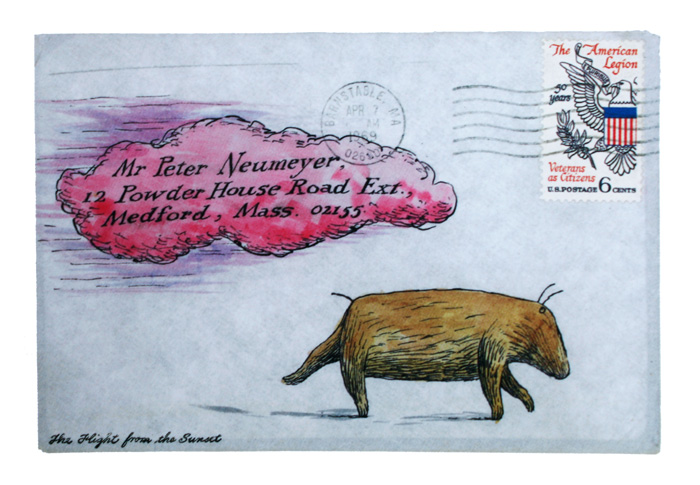
Edward Gorey fans rejoice! There's a new book out of his correspondence.

From a piece on Brain Pickings...

It’s no secret we’re big fans of Edward Gorey’s, mid-century illustrator of the macabre, whose work influenced generations of creators, from Nine Inch Nails to Tim Burton. Between September 1968 and October 1969, Gorey set out to collaborate on three children’s books with author and editor Peter F. Neumeyer and, over the course of this 13-month period, the two exchanged a series of letters on topics that soon expanded well beyond the three books and into everything from metaphysics to pancake recipes.

Today, Neumeyer is opening the treasure trove of this fascinating, never-before-published correspondence in Floating Worlds: The Letters of Edward Gorey and Peter F. Neumeyer — a magnificent collection of 75 typewriter-transcribed letters, 38 stunningly illustrated envelopes, and more than 60 postcards and illustrations exchanged between two collaborators-turned-close-friends, featuring Gorey’s his witty, wise meditations on such eclectic topics as insect life, the writings of Jorge Luis Borges, and Japanese art.

Monday, August 29, 2011

The Ecstacy of Influence - a Plagiarism


Jonathan Lethem, in Harper's, discusses artistic appropriation and plagiarism.


From said piece...


“When you live outside the law, you have to eliminate dishonesty.” The line comes from Don Siegel's 1958 film noir, The Lineup, written by Stirling Silliphant. The film still haunts revival houses, likely thanks to Eli Wallach's blazing portrayal of a sociopathic hit man and to Siegel's long, sturdy auteurist career. Yet what were those words worth—to Siegel, or Silliphant, or their audience—in 1958? And again: what was the line worth when Bob Dylan heard it (presumably in some Greenwich Village repertory cinema), cleaned it up a little, and inserted it into “Absolutely Sweet Marie”? What are they worth now, to the culture at large?


Appropriation has always played a key role in Dylan's music. The songwriter has grabbed not only from a panoply of vintage Hollywood films but from Shakespeare and F. Scott Fitzgerald and Junichi Saga's Confessions of a Yakuza. He also nabbed the title of Eric Lott's study of minstrelsy for his 2001 album Love and Theft. One imagines Dylan liked the general resonance of the title, in which emotional misdemeanors stalk the sweetness of love, as they do so often in Dylan's songs. Lott's title is, of course, itself a riff on Leslie Fiedler's Love and Death in the American Novel, which famously identifies the literary motif of the interdependence of a white man and a dark man, like Huck and Jim or Ishmael and Queequeg—a series of nested references to Dylan's own appropriating, minstrel-boy self. Dylan's art offers a paradox: while it famously urges us not to look back, it also encodes a knowledge of past sources that might otherwise have little home in contemporary culture, like the Civil War poetry of the Confederate bard Henry Timrod, resuscitated in lyrics on Dylan's newest record, Modern Times. Dylan's originality and his appropriations are as one.


The same might be said of all art.

Tuesday, August 16, 2011

Frida Kahlo and Edgar Allan Poe


A book of Poe's work, annotated by none other than painter Frida Kahlo sold at auction recently.


From a piece on the Paul Fraser Collectibles site...


In a different sphere, celebrated Mexican artist Frida Kahlo is also highly coveted by collectors, and her works have attracted six and seven figure bids.


Obviously the two are not usually related. But at Leslie Hindman's auction earlier this week one lot will have interested collectors of both kinds:


The beaten-up copy of The Works of Edgar Allan Poe was covered the book with doodles, inscriptions, paint and collaged leaves by Kahlo.