Showing posts with label science fiction. Show all posts
Showing posts with label science fiction. Show all posts
Thursday, November 3, 2011

Friday, October 21, 2011
Thursday, October 20, 2011
Speculative Reading Flowchart Fun!

Apparently NPR had a "Best 100 Science Fiction" books contest and the NPR readership voted in an extremely mixed bag of the 100 best novels. It says a lot more about the changing nature of today's reading demographic that some of the books on this list made it in, I suppose....but hey, I can't say any single one of the books chosen isn't good, and I've read close to half of what's on the list and can't claim disappointment with any of these choices.
That said, these guys here made an amazing flowchart to help you pick from the Top 100 mix to find your own personal book preference. It's a pretty amusing flowchart....so now you too can find that Special Book!

Monday, October 10, 2011
The First Lesbian Science Fiction Novel

It was published in 1906.
From a piece in io9...
Like most genres of popular literature, science fiction has been slow to present lesbians in a positive light. During the late 19th century and early 20th century, lesbians were entirely unrepresented in science fiction, with homosexuality an act only depraved men engaged in. Which makes Gregory Casparian's The Anglo-American Alliance. A Serio-Comic Romance and Forecast of the Future (1906), the first lesbian science fiction novel, all the more notable.
Casparian (1855-1947) was a Turkish Armenian who emigrated to the United States in 1877 after making himself unwelcome in Turkey as an officer in the Armenian army. He settled in New York and became an artist, painter, and photoengraver for an engineering firm. Little else can be found about him, but he must have been an interesting and thoughtful man, for The Anglo-American Alliance, his only book, is remarkably progressive sexually.
Tuesday, October 4, 2011
Does Great Science Require Great Science Fiction?

That was the question recently posed on Big Think.
From the piece...
I enjoyed this recent article by Neal Stephenson in the World Policy Journal, but I think he and his editors may have buried their lede. Stephenson, a bestselling science fiction (SF) author who grew up watching the Apollo missions, is concerned about the lack of visionary science and engineering projects in our own time. Accordingly, he frames his essay as a lament about the decline of American innovation, of "our ability to get important things done," and so on. We've all seen plenty of commentary to this effect, especially since the Space Shuttle completed its last mission. Midway through, however, Stephenson recounts the following anecdote from a 2011 conference called Future Tense:
“You’re the ones who’ve been slacking off!” proclaims Michael Crow, president of Arizona State University (and one of the other speakers at Future Tense). He refers, of course, to SF writers. The scientists and engineers, he seems to be saying, are ready and looking for things to do. Time for the SF writers to start pulling their weight and supplying big visions that make sense. Hence the Hieroglyph project, an effort to produce an anthology of new SF that will be in some ways a conscious throwback to the practical techno-optimism of the Golden Age.
This struck me as a remarkable claim—not on Stephenson's part, of course, but Crow's. It's one thing for authors to trumpet their own importance, but to see a university president actually call on fiction writers to lead the country forward is startling. In effect he asks them: how can America have a great future unless you imagine it for us?
Wednesday, September 28, 2011

Saturday, September 24, 2011
Books and on Looting Borders' Smoldering Corpse
I've been reading some good books lately, thought I'd take a bit of time to share. I'm one of those biblioholics out there, so naturally I am deeply concerned about the future of print media, trees be damned, but sooner or later I guess I'll have to adopt some sort of reading tablet and get up with the times. In the meantime, I've taken full advantage of Borders' corpse and looted it for all it was worth; I have about 100 new books* on my shelf now demanding attention, and I'm already wondering if the baby is going to object to me reading him things like The Seal of Karga Kul or Zombie CSU. I figure I'm good, at least until the poor little guy starts developing real language and comprehension skills, and is suddenly mortified to discover that his parents are a couple of uncool geeks...!
Anyway, some books I would strongly recommend:

The Edge of Physics by Anil Ananthaswamay is a great read, a chapter-by-chapter journey in which Anil travels to various remote corners of the world where physicists, astronomers and sundry other researchers are relying on the unique conditions of specific locales to do their research. It's a great read, with a fair amount of insight on how and why these remote institutes come into being and the trials and tribulations involved in doing the research in such exotic locations.
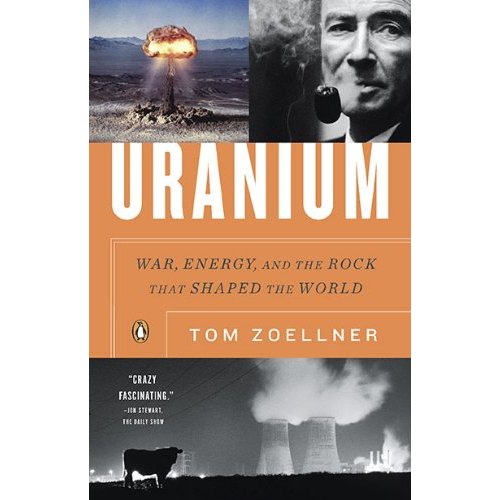
Tom Zoellner wrote Uranium which I am in the middle of and absolutely loving it. It's an engaging read (unlike Rhodes, who may know his stuff but I found tedious to plow through) and provides a great variety of interesting history and data on the discovery, development, research and seedy hidden details of the history of uranium. Well worth reading, and very engaging.

In fantasy, I finished Tim Waggoner's Thieves of Blood, the first volume of the Blade of the Flame trilogy set in the world of Eberron. It was a good read, with some very distinct characters, and a plot and pacing in style for the pulp fantasy world of Eberron. I'm looking forward to reading the next two books in the series now. My only gripe really was that clearly Wizards of the Coast was employing some lazy editors back in 2006 when this book came out, as there were a fair number of typographical errors best attributed to someone who was spell-checking with Office Word 2003 rather than properly proofing the manuscript by hand. That doesn't detract from the author's work, though.

Aside from the above mentioned books I'm plowing once again through Salvatore's Drizzt Do'Urden novels, which I read many years ago, around 1999-2000, getting up to around book 10 before I ran out of steam and took a break, never finding the time to return. Well thanks to the Looting of Borders I have all of the Salvatore Forgotten Realms novels to date, and plan to work my way through them, restarting with Homeland (in the can) and moving on from there. I'm sure everyone's familiar with these books, but I'll only comment to say that I am consistently impressed at how engaging and simple Salvatore's writing is, and how evocative his books are; I really do consider the first Drizzt trilogy to be among the best fantasy I have ever read.
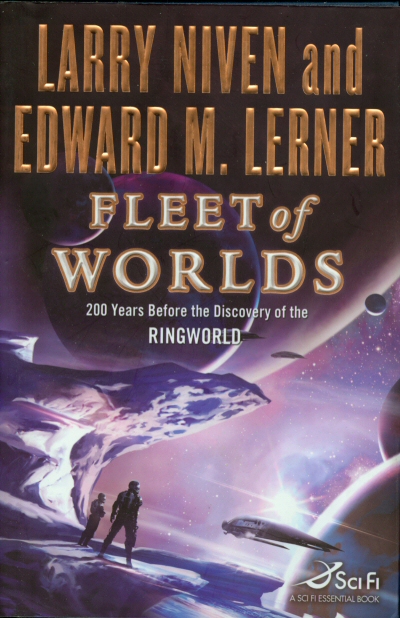
Aside from all the fantasy, I'm also finally picking up Larry Niven's Known Space prequel series (co-written with Edward Lerner), and just finished Fleet of Worlds a few weeks ago. I haven't started Juggler of Worlds yet, but I will soon; I've also been catching up on his other collections such as N-Space and Crashlander. I really love Niven's Known Space universe, and its fun to read new books in the setting, revisit the classic Known Space tales, and watch how the authors try to reconcile the inconsistencies and evolving science of a series written over nearly five decades!
My wife says this is common among imminent first-time fathers, who try desperately to get all that last-minute living in before B-Day and the Loss of All Personal Freedom arrives. I guess I'll save my staggering video game exploits in recent months for another column...
 *if you're following my blog and have noted my lamentation at not getting the Tome of Horrors Complete, I will admit that the 100 odd books I bought at Borders in its closing days probably had more to do with that than all the money I've spent on baby gear....sigh, such is the life of a biblioholic, sacrifices must be made and all that noise....!
Anyway, some books I would strongly recommend:
The Edge of Physics by Anil Ananthaswamay is a great read, a chapter-by-chapter journey in which Anil travels to various remote corners of the world where physicists, astronomers and sundry other researchers are relying on the unique conditions of specific locales to do their research. It's a great read, with a fair amount of insight on how and why these remote institutes come into being and the trials and tribulations involved in doing the research in such exotic locations.
Tom Zoellner wrote Uranium which I am in the middle of and absolutely loving it. It's an engaging read (unlike Rhodes, who may know his stuff but I found tedious to plow through) and provides a great variety of interesting history and data on the discovery, development, research and seedy hidden details of the history of uranium. Well worth reading, and very engaging.
In fantasy, I finished Tim Waggoner's Thieves of Blood, the first volume of the Blade of the Flame trilogy set in the world of Eberron. It was a good read, with some very distinct characters, and a plot and pacing in style for the pulp fantasy world of Eberron. I'm looking forward to reading the next two books in the series now. My only gripe really was that clearly Wizards of the Coast was employing some lazy editors back in 2006 when this book came out, as there were a fair number of typographical errors best attributed to someone who was spell-checking with Office Word 2003 rather than properly proofing the manuscript by hand. That doesn't detract from the author's work, though.
Aside from the above mentioned books I'm plowing once again through Salvatore's Drizzt Do'Urden novels, which I read many years ago, around 1999-2000, getting up to around book 10 before I ran out of steam and took a break, never finding the time to return. Well thanks to the Looting of Borders I have all of the Salvatore Forgotten Realms novels to date, and plan to work my way through them, restarting with Homeland (in the can) and moving on from there. I'm sure everyone's familiar with these books, but I'll only comment to say that I am consistently impressed at how engaging and simple Salvatore's writing is, and how evocative his books are; I really do consider the first Drizzt trilogy to be among the best fantasy I have ever read.
Aside from all the fantasy, I'm also finally picking up Larry Niven's Known Space prequel series (co-written with Edward Lerner), and just finished Fleet of Worlds a few weeks ago. I haven't started Juggler of Worlds yet, but I will soon; I've also been catching up on his other collections such as N-Space and Crashlander. I really love Niven's Known Space universe, and its fun to read new books in the setting, revisit the classic Known Space tales, and watch how the authors try to reconcile the inconsistencies and evolving science of a series written over nearly five decades!
My wife says this is common among imminent first-time fathers, who try desperately to get all that last-minute living in before B-Day and the Loss of All Personal Freedom arrives. I guess I'll save my staggering video game exploits in recent months for another column...
Tuesday, September 6, 2011

Friday, September 2, 2011
Saturday, August 13, 2011

Wednesday, August 3, 2011


Tuesday, July 12, 2011
Secret Histories

The Los Angeles Review of Books explores the world of steampunk.
From the piece...
Rachel Bowser and Brian Croxall, the co-editors of a recent special issue on steampunk in the online journal Neo-Victorian Studies, make much the same point when they suggest that steampunk visual art is a critical response to the “opacity” of contemporary technology, its imperviousness to tinkering, and its discouragement of amateur repair. Rooted in the “maker” and do-it-yourself movements, steampunk rejects planned obsolescence, and this helps explain its propensity for mixing together materials from different time periods, as in the artist Datamancer’s laptop computers fashioned out of wood and leather and ornamented with brass bear-claw feet and a large brass key as the on/off switch. Anachronism, they claim, is steampunk’s primary formal principle: “it creates a new paradigm in which technologies, aesthetics, and ideas mark different times simultaneously, instead of signposting different historical periods; anachronism is not anomalous but becomes the norm.”
Anachronism is as central to steampunk fiction as it is to fashion and visual art. The term “steampunk,” in fact, was originally coined in reference to fiction by the American science fiction writer K.W. Jeter in an April, 1987 essay in Locus magazine: “I think Victorian fantasies are going to be the next big thing,” he wrote, “as long as we can come up with a fitting collective term for [them] … like ‘steampunk’ perhaps.” Though largely overshadowed by its bigger, slicker brother “cyberpunk,” steampunk fiction did become an interesting development in science fiction over the next two decades. The grand achievement of the early days of the subgenre, by most accounts, is William Gibson and Bruce Sterling’s The Difference Engine (1991), a novel that projects a decidedly darker vision than most contemporary steampunk art. It is set in an alternative mid-nineteenth-century London where a technological breakthrough, the invention of mechanical computing machines, has ushered in a radically secular political regime — alternative history in an anachronistic mode. Lord Byron, in this world, has become a powerful Prime Minister rather than a poet. But London’s thriving trade in prostitution is unchanged, and its air pollution is even worse. Other notable examples, ones not necessarily identified as steampunk by their authors but sometimes claimed as part of the subgenre’s genealogy, include Philip Pullman’s highly successful trilogy His Dark Materials (1995-2000), with its very recognizable Oxford set in a fantastic alternative universe, China Miéville’s critically acclaimed New Crobuzon trilogy (Perdido Street Station [2003], The Scar [2004], and Iron Council [2005]), which clearly models the nation of New Crobuzon on imperial-era England, and even Thomas Pynchon’s mammoth historical novel Against the Day (2006), with its elaborate play upon Victorian speculations about time travel and multiple-dimensional realities.
Subscribe to:
Comments (Atom)